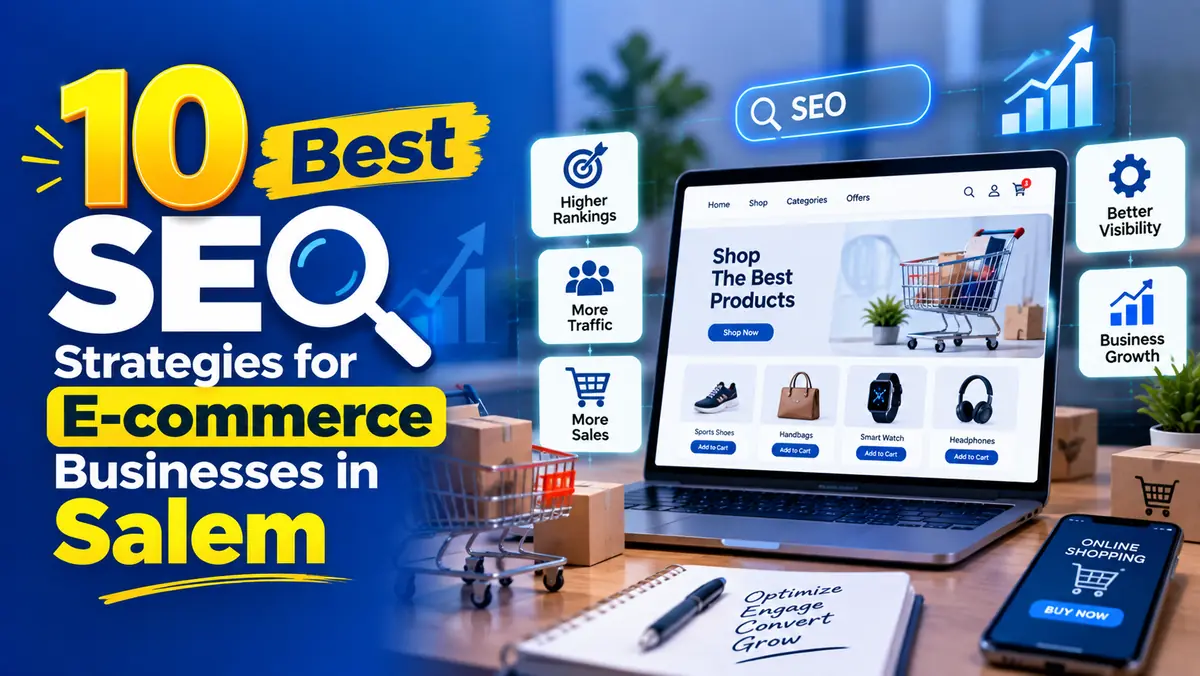
10 Best SEO Strategies for E-commerce Businesses in Salem
E-commerce businesses need more than attractive products and a professional website to succeed online. Customers must be able to find your products when they search on Google. This is why the Best SEO Strategies for E-commerce Businesses in Salem are important for online store owners who want to increase organic traffic, improve search visibility, attract relevant customers, and generate more online sales.
Whether you sell clothing, electronics, beauty products, home products, handmade items, groceries, or speciality products, a well-planned e-commerce SEO strategy can help your business compete in the digital marketplace.
What Is E-commerce SEO?
E-commerce SEO is the process of improving an online store so that its product pages, category pages, website content, and technical structure can appear more effectively in search engine results.
E-commerce SEO focuses on:
- Product and category keyword optimisation
- Website speed and mobile usability
- Search-friendly product descriptions
- Technical SEO and website structure
- Internal linking
- Helpful content and product guides
- Online store trust and user experience
Why SEO Is Important for E-commerce Businesses in Salem
Many customers search online before purchasing a product. They compare prices, read reviews, check product features, and look for reliable online stores. If your website does not appear in relevant search results, potential customers may visit competitor websites instead.
SEO can help e-commerce businesses:
- Increase organic website traffic
- Improve product visibility on Google
- Reach customers searching for specific products
- Reduce dependency on paid advertising over time
- Build long-term online brand visibility
- Improve product discovery and customer experience
- Generate more enquiries, orders, and sales opportunities
10 Best SEO Strategies for E-commerce Businesses in Salem
1. Conduct Proper E-commerce Keyword Research
Keyword research is the foundation of a successful e-commerce SEO campaign. It helps you understand what your target customers search for when they are looking for products online.
Instead of targeting only broad keywords such as “clothing” or “shoes,” identify specific keywords related to your products, categories, and customer needs.
Examples of e-commerce keywords include:
- Buy cotton shirts online
- Women’s ethnic wear online
- Best skincare products online
- Affordable home decor products
- Online grocery delivery in Salem
- Buy handmade gifts online
- Best online clothing store in Salem
Use relevant keywords naturally in product titles, product descriptions, category pages, headings, image alt text, and blog content. Select keywords based on search intent, competition, product relevance, and customer expectations.
2. Optimise Product Titles and Descriptions
Product titles and descriptions help both search engines and customers understand what you are selling. A clear and informative product title can improve product relevance and make it easier for users to identify the right item.
A good product title should include important details such as:
- Product name
- Brand name, if relevant
- Product type
- Colour or size, if important
- Main product benefit or feature
Product descriptions should explain the product’s features, benefits, materials, size, usage, care instructions, delivery details, and other relevant information. Avoid copying descriptions from manufacturers or competitor websites. Write unique content that helps customers make informed purchase decisions.
3. Create SEO-friendly Product and Category URLs
Clean and descriptive URLs help users and search engines understand the structure of your online store. Your URLs should be short, readable, and related to the product or category.
For example:
- Good URL: `https://example.com/mens-cotton-shirts`
- Less useful URL: `https://example.com/product?id=12345`
Use descriptive words, avoid unnecessary numbers and symbols, and maintain a logical website structure. If you change existing URLs, use suitable redirects to avoid broken links and loss of existing search visibility.
4. Improve Website Speed and Mobile Experience
Many customers browse and purchase products using mobile phones. A slow or difficult-to-use website can lead to frustration, abandoned carts, and fewer sales opportunities.
Improve your e-commerce website by:
- Compressing product images
- Using modern image formats where suitable
- Reducing unnecessary plugins and scripts
- Choosing reliable website hosting
- Improving mobile navigation
- Reducing unnecessary pop-ups
- Making buttons and product filters easy to use
- Improving page loading performance
A mobile-friendly website should make it easy for customers to browse products, select variations, add items to the cart, complete payment, and contact your business if they need support.
5. Optimise Product Images and Image Alt Text
Product images are essential for e-commerce websites. High-quality images help customers understand the product and can also support visibility in image search results.
Follow these image SEO practices:
- Use clear and high-quality product images
- Compress images without reducing important quality
- Use descriptive image file names
- Add accurate image alt text
- Show products from multiple angles
- Use suitable image dimensions
- Include product details in captions when useful
For example, instead of using an image file name such as `IMG1234.jpg`, use a descriptive name such as `blue-cotton-mens-shirt.jpg`. Alt text should describe the image naturally and should not contain unnecessary keyword repetition.
6. Build Strong Internal Linking
Internal linking connects different pages within your website. It helps users discover related products and allows search engines to understand the relationship between your website pages.
Useful internal links may connect:
- Homepage to important product categories
- Category pages to individual product pages
- Product pages to related products
- Blog posts to product and category pages
- Buying guides to relevant products
- Seasonal landing pages to promotional collections
Use descriptive anchor text such as “shop cotton shirts,” “explore skincare products,” or “view home decor collections.” Avoid using the same keyword-rich anchor text repeatedly on every page.
7. Create Helpful E-commerce Blog Content
Blogging helps e-commerce businesses target informational searches and attract customers before they are ready to purchase. Helpful content can also support product discovery and build trust.
Blog topics for online stores may include:
- How to choose the right product
- Product comparison guides
- Product care and maintenance tips
- Latest fashion or lifestyle trends
- Gift ideas for special occasions
- Common customer questions
- Benefits and features of different products
- Buying guides for first-time customers
For example, an online clothing store in Salem can publish articles about choosing cotton clothing for the local climate, styling traditional outfits, or selecting the right size. Include relevant internal links from these blog posts to your product and category pages.
8. Optimise Category Pages for Search Intent
Category pages are often important landing pages for e-commerce websites. They help customers browse related products and can rank for valuable commercial keywords.
A well-optimised category page should include:
- A clear and descriptive category heading
- A short introductory description
- Relevant products and filters
- Useful category-specific content
- SEO-friendly title and meta description
- Links to related categories
- Helpful FAQs, when appropriate
Avoid creating many thin category pages with little useful content. Each category should provide a clear purpose and help users find the products they are looking for.
9. Improve Product Reviews and Customer Trust Signals
Customers want to feel confident before purchasing from an online store. Reviews, ratings, clear policies, and transparent business information can improve customer confidence.
Important trust elements include:
- Genuine customer reviews
- Product ratings
- Clear return and refund policies
- Secure payment information
- Delivery and shipping details
- Customer support contact details
- About Us page
- Privacy policy and terms of service
Encourage genuine customer feedback after purchase. Do not publish fake reviews or misleading testimonials. Make sure review content is relevant to the actual product and customer experience.
10. Use Technical SEO and Track Performance
Technical SEO helps search engines crawl, understand, and index your e-commerce website. Online stores can contain hundreds or thousands of product pages, so technical optimisation is especially important.
Important technical SEO activities include:
- Submitting an XML sitemap
- Checking website indexing
- Fixing broken links
- Managing duplicate product pages
- Using canonical tags where required
- Improving website security with HTTPS
- Checking mobile usability
- Optimising website navigation
- Monitoring crawl errors
- Reviewing search performance regularly
You can use tools such as Google Search Console and Google Analytics to monitor website traffic, search queries, clicks, impressions, and customer behaviour. Review the data regularly and improve pages that are not performing well.
Google also provides useful guidance through its SEO Starter Guide .
Local SEO Tips for E-commerce Businesses in Salem
If your e-commerce business operates from Salem and also serves local customers, local SEO can help you connect with nearby buyers. This is especially useful for businesses that offer local delivery, store pickup, or service within Salem and surrounding areas.
Local e-commerce SEO activities may include:
- Creating a location-focused website page
- Using Salem-related keywords naturally
- Displaying accurate business contact details
- Optimising your Google Business Profile when eligible
- Adding local delivery and pickup information
- Publishing Salem-focused blog content
- Building relevant local business mentions
Avoid adding Salem keywords to every product page when the products are available nationally or internationally. Use location-based keywords only where they match your actual service area and customer intent.
Common E-commerce SEO Mistakes to Avoid
Many online store owners make SEO mistakes that can affect visibility and customer experience. Avoid the following:
- Copying product descriptions from other websites
- Using the same title and meta description on every page
- Uploading large, uncompressed product images
- Ignoring mobile website performance
- Creating duplicate product URLs
- Using too many unnecessary keywords
- Ignoring broken links and crawl errors
- Publishing fake customer reviews
- Creating thin category pages
- Not tracking SEO performance
How Visagan Digital Edge Can Help Your E-commerce Business
Visagan Digital Edge provides digital marketing and SEO solutions for businesses that want to improve their online visibility. Our team can help e-commerce businesses create a stronger digital presence through website optimisation, SEO, content marketing, Google Ads, and other digital marketing services.
Our e-commerce marketing support can include:
- E-commerce website SEO
- Product and category keyword research
- On-page SEO optimisation
- Technical SEO improvements
- Product description optimisation
- Content marketing and blog writing
- Google Search performance tracking
- Google Ads and shopping campaign support
Explore our SEO services to learn how search engine optimisation can support your online store’s growth.
You can also visit our digital marketing services page to explore website development, advertising, branding, and online marketing solutions.
Frequently Asked Questions
1. What is the main focus of e-commerce SEO?
The main focus of e-commerce SEO is to improve the visibility of product pages, category pages, and website content so that relevant customers can discover the online store through search engines.
2. How long does e-commerce SEO take to show results?
SEO results depend on website quality, competition, product demand, technical performance, content quality, and consistency. Some improvements may appear earlier, while stronger organic growth usually requires ongoing effort.
3. Are product descriptions important for SEO?
Yes. Unique and helpful product descriptions can improve product relevance, explain product benefits, answer customer questions, and support a better shopping experience.
4. Is local SEO useful for online stores in Salem?
Local SEO can be useful when an online store serves Salem customers through local delivery, store pickup, or a location-based service area. Use local keywords only when they match the business’s actual offering.
5. Should an e-commerce website have a blog?
A blog can help an e-commerce website attract informational search traffic, answer customer questions, promote products, and create internal links to important product and category pages.
6. Can SEO reduce paid advertising costs?
SEO can help generate organic traffic over time, which may reduce dependence on paid advertising for some search queries. However, SEO and paid advertising serve different purposes and can work together as part of a broader marketing strategy.
Conclusion
A strong SEO strategy is essential for e-commerce businesses that want to attract customers and grow online sales. By implementing the Best SEO Strategies for E-commerce Businesses in Salem, online store owners can improve product visibility, optimise website performance, build customer trust, and create a better shopping experience.
Start with keyword research, unique product descriptions, SEO-friendly URLs, fast mobile performance, optimised images, internal linking, helpful content, strong category pages, genuine reviews, and technical SEO. Consistent optimisation and regular performance tracking can help your e-commerce business build long-term online visibility.
Want to improve your e-commerce website rankings? Contact Visagan Digital Edge for professional SEO and digital marketing support in Salem.